Patt engineering guides
Screen changer engineering comparison
Compare rotary, slide-plate, dual-piston, belt and scraper screen changers by renewal, pressure control, backwashing and application requirements.
Engineering reference
Six screen changer architectures
Select a screen changer and polymer melt filtration system by the complete process: stable flow, contaminant removal, screen renewal, backwashing, melt loss and cleanout. Architecture alone does not determine a pressure spike or guarantee resin compatibility.
| Architecture | Screen renewal & continuity | Pressure behavior | Media & interfaces | Application review |
|---|---|---|---|---|
| Manual slide-plate screen changer | Operator shifts the screen carrier; the line generally pauses or reduces output. | Pressure rises with loading and changes at renewal; actual transient is line-specific. | Periodic screen packs; inspect the sliding interface. | Review shutdown time, retained melt and restart scrap. |
| Hydraulic slide-plate screen changer | Powered exchange shortens the stroke; flow continuity depends on design. | Changeover and filling strategy determine the pressure excursion. | Screen packs and a moving plate / sealing interface. | Check purge sequence, temperature control and residence time. |
| Dual-piston / double-bolt | One flow path can remain online during service; backflush versions are available. | Modern controlled systems can provide pressure-stable continuous operation. | Screens, close-clearance piston interfaces and model-specific seals. | Review backflush melt loss, filling, venting and dead-volume control. |
| Continuous belt screen changer (ribbon) | A roll of mesh advances through the melt; roll renewal still needs planning. | Design-dependent: a published Key Filters example specifies variation as low as ±20 psi (about ±1.38 bar). | Continuous mesh supply; polymer sealing and advancement differ by design. | Check resin suitability, sealing temperatures and contamination handling. |
| Scraper / laser-disc | A scraper removes retained debris from a rigid filtering element during production. | Contaminant extraction and control settings affect the pressure trace. | Rigid perforated element, scraper wear and reject stream. | Match holes and cleaning action to soft contaminants, gels, fillers and resin. |
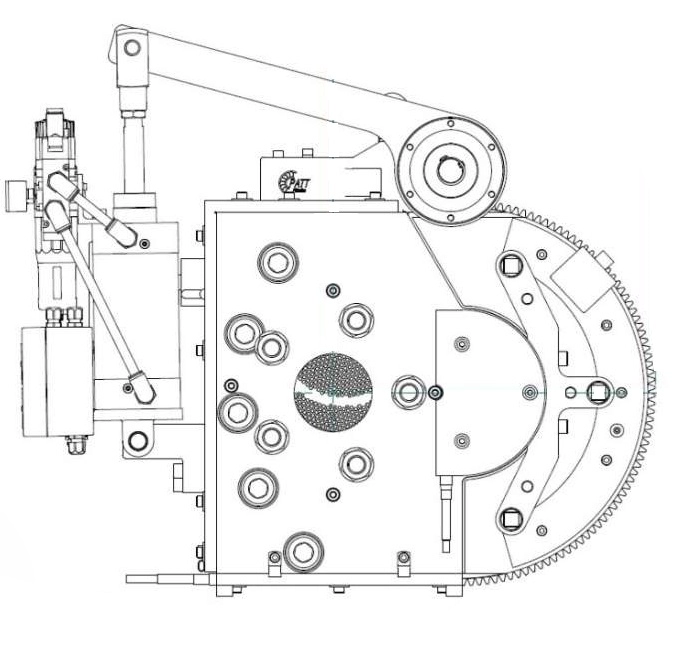
| Patt constant-pressure rotary disc screen changer | Continuous rotary screen renewal with backwashing; routine screen replacement occurs outside the active melt path. | Configurable down to ±1 bar (±14.5 psi); confirm the measurement point and application conditions. | Rigid carrier disk and precision metal-to-metal wear surfaces; no chilled polymer plugs. | Rotary III for extrusion / recycling; Rotary IV monoblock for PCR, rigid PVC and aggressive polymers. |
Compare pressure traces at the same sensor location, throughput, resin, contamination load and filtration target. ±1 bar is a configured Patt capability, not a guaranteed result for every line. Continuous filtration does not eliminate all maintenance stops. Pressure variation figures from different manufacturers are not directly comparable without matched test conditions.
Engineering reference
Compare like-for-like process measurements
| Measurement | Record together | Why it matters |
|---|---|---|
| Pressure stability | Inlet and outlet sensor locations, sampling interval, peak-to-peak range and screen-change event | Separates filter differential pressure from downstream extrusion pressure. |
| Throughput and filtration | Resin grade, melt temperature, kg/h, element construction and target retention | Makes pressure and flow results comparable. |
| Contamination | Type, size distribution, concentration and retained mass over time | Shows how representative the trial is of the production feed. |
| Screen renewal and backwashing | Cycle frequency, reject / purge mass, media consumption and operator time | Quantifies the operating cost of keeping the melt clean. |
| Thermal exposure and cleanout | Melt hold-up, low-flow regions, purge method and material-change time | Supports selection for rigid PVC and other thermally sensitive polymers. |
| Production availability | Routine screen change, roll / element replacement and planned maintenance separately | Avoids treating continuous filtration as zero lifetime downtime. |
A useful trial report states the baseline, the measurement method and the resin / screen configuration beside each result. Use measured pressure, throughput, media use and melt-loss data to calculate the economics of the proposed screen changer.
Engineering reference
Rotary III, Rotary IV & Colossus
Designed and manufactured in Saint-Eustache (Greater Montreal), Quebec, Canada since 1986, Patt continuous screen changers span 10 to 7,000 cm² of active filtration area with configured filtration down to 1 µm, differential-pressure stability configurable down to ±1 bar (±14.5 psi) via Rotary Control, operating temperatures up to 350 °C standard / 450 °C high-temperature, and operating pressures up to 448 bar (6,500 psi).
Rotary III (seven frame sizes A–G, 10–1,990 cm²) is the go-to constant-pressure continuous rotary screen changer with self-cleaning backwashing for standard extrusion, blown film, sheet, pipe, compounding and clean regrind. Rotary IV (four monoblock sizes A–D, 10–385 cm²) is recommended alongside Rotary III for post-consumer recycled plastics (PCR), washed flake and tramp materials, and is recommended exclusively for melts subject to thermal breakdown, corrosive off-gassing or requiring stainless construction — including rigid and flexible PVC (uPVC, CPVC), fluoropolymers (PVDF, ETFE, ECTFE, FEP, PFA) and high-temperature engineering plastics (PEEK, PEKK, PEI, PSU, PPSU, PPS, LCP, PPA). Colossus (sizes C–D, 1,385–7,000 cm²) is a modular candle screen changer with continuous candle replacement and backwashing (including optional pulsed solvent backwashing) reserved for ultra-fine melt filtration (≤ 60 µm) or duties exceeding a single rotary disk frame. Adding Patt wave-shaped breaker plates increases active screen area by 1.8× within the same breaker-plate outer diameter (~15 mm extra housing width).
Run the interactive two-mode Filtration Sizing Calculator to compute required active filtration area from two-zone Power-Law shear-thinning rheology or back-solve a continuous rotary upgrade from existing slide-plate pressures.
Return to Continuous screen changers & melt filtration · All engineering guides
Discuss your project
Tell us what you need.
Send the polymer, throughput and operating conditions, or the drawing and material requirements for your part.
sales@patt-tech.com