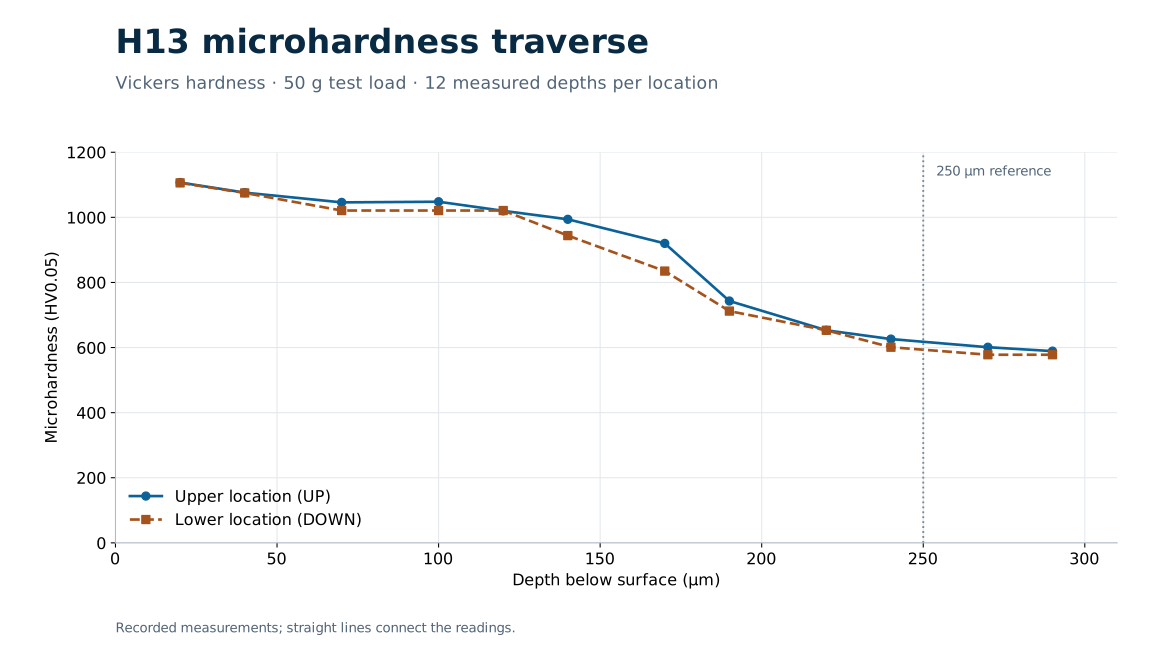
H13 plasma nitriding: case depth and hardness
Review the micrographs and 24-point microhardness traverse from the published technical case study.
ExploreFiltration engineering
Size the active filtration area from melt rheology, screen rating and contamination load, or back-solve a rotary upgrade from your existing slide-plate pressures. Compare the result with published Patt frame sizes.
Two-zone power-law (shear-thinning) pressure-drop model with contamination-loading limits, for preliminary screen changer sizing. Results update as you type.
| Frame | Active area | Application match | Details |
|---|---|---|---|
| Rotary III (A–G) | 10–1,990 cm² | Go-to constant-pressure rotary platform for extrusion & recycling | Specifications |
| Rotary IV (A–D) | 10–385 cm² | Recommended with Rotary III for PCR/flake/tramp, or exclusively for breakdown, off-gassing & stainless duty | Specifications |
| Colossus (C–D) | 1,385–7,000 cm² | Modular candle elements reserved for ultra-fine filtration (≤ 60 μm) | Specifications |
No single published frame covers this area. Patt can review Colossus, parallel or custom configurations.
Rotary III is the go-to suggestion for standard extrusion; Rotary IV is recommended alongside Rotary III for PCR, flake and tramp materials, or exclusively for melts subject to breakdown, off-gassing or requiring stainless construction; Colossus is recommended only for ultra-fine filtration (≤ 60 μm).
| Changer architecture | Spatial × temporal (ηeff) | Effective working area | Equiv. bore needed |
|---|---|---|---|
| Patt continuous rotary (III / IV) | 69.0% limit / 69.0% avg | — cm² | — cm² |
| Continuous belt / ribbon | 57.1% limit / 57.1% avg | — cm² | — cm² |
| Slide plate (discontinuous) | 21.8% limit / 49.9% avg | — cm² | — cm² |
| Bolt / piston (discontinuous) | 23.0% limit / 44.6% avg | — cm² | — cm² |
Efficiency factors are Patt planning assumptions for comparing architectures at equal duty, not measured results for any specific manufacturer’s equipment.
Engineering reference
Estimate active filtration area from throughput, then check pressure loss, screen construction and contamination using the calculator above. Area is measured in cm² or in²; it is not a volume in cm³.
| Polymer family / process duty | Recommended Patt platform | Key design & metallurgy features | Interactive calculator sizing |
|---|---|---|---|
| Standard extrusion, blown film, sheet, pipe & clean regrind | Rotary III (A–G, 10–1,990 cm²1.55–308.45 in²) | Go-to constant-pressure continuous rotary screen changer with self-cleaning backwashing; configurable down to ±1 bar (±14.5 psi) with Rotary Control. | Select the polymer preset in Mode 1 above to compute required active area from shear-thinning Δp. |
| Post-consumer recycle (PCR), washed flake & tramp materials | Rotary III (A–G) alongside Rotary IV (A–D, 10–385 cm²1.55–59.68 in²) | Continuous rotary indexing and backwashing clear heavy contaminant loads while hardened wear surfaces handle abrasive PCR and tramp inclusions. | Select Standard PCR or Heavy PCR / flake / tramp in Mode 1, or back-solve from slide-plate data in Mode 2. |
| Rigid & flexible PVC, fluoropolymers & high-temp breakdown / off-gassing melts | Rotary IV (A–D, 10–385 cm²1.55–59.68 in²) exclusively | Streamlined monoblock flow passages and stainless / corrosion-resistant metallurgy for uPVC, CPVC, PVDF, ETFE, ECTFE, FEP, PFA, PEEK, PEI, PSU, PPSU, PPS, LCP and PPA (up to 450 °C). | Select the PVC, fluoropolymer or high-temperature preset in Mode 1; frame recommendations automatically restrict to Rotary IV. |
| Ultra-fine melt filtration (≤ 60 μm / 250–500 mesh) | Colossus (C–D, 1,385–7,000 cm²214.68–1,085 in²) alongside rotary frames | High-area modular candle filter elements with continuous candle replacement and backwashing (including optional pulsed solvent backwashing). | Enter a target screen rating ≤ 60 μm in Mode 1 or Mode 2 to include Colossus candle configurations. |
| Space-constrained retrofits (1.8× active screen area) | Patt wave-shaped breaker plates & shaped screen packs | Increases active filtration screen area by 1.8× within the same nominal breaker-plate outer diameter while adding only ~15 mm of housing width. | Review the 1.8× wave-shaped pack KPI in Mode 1 to evaluate fitting one frame size smaller. |
| Application / resin | Filtration target to provide | Sizing factors to check | Recommended Patt system |
|---|---|---|---|
| LDPE / LLDPE film | Required micron rating, retention method and film defect limit | Fine-layer resistance, gel behavior, ±1 bar gauge stability and recycled-content variation | Rotary III with Rotary Control; add wave breaker plates for 1.8× screen area. |
| HDPE pipe & profile | Screen construction and allowable inclusion size | Fractional-melt viscosity, pressure budget, carbon black / filler content and production rate | Rotary III (go-to); review Rotary IV alongside Rotary III when running PCR or flake. |
| PP sheet & compounding | Screen construction and surface / inclusion requirement | Filled versus unfilled material, screen pressure loss and contamination load | Rotary III (A–G, 10–1,990 cm²). |
| PET, PA & optical resins (PC, PMMA) | Micron rating, screen construction and optical / mechanical requirement | Moisture control, melt temperature, residence time and fine gel or black-speck retention | Rotary III for standard filtration; Colossus for ultra-fine (≤ 60 μm) candle duties. |
| Rigid & flexible PVC (uPVC, CPVC) | Micron rating and acceptable contaminant / burn-mark level | Thermal shear exposure, flow-channel cleanout, HCl off-gassing and corrosion resistance | Rotary IV monoblock exclusively. |
| High-temperature plastics & fluoropolymers (PEEK, PEI, PPS, PVDF, FEP, PFA) | Micron rating, operating temperature (up to 450 °C) and metallurgy requirement | High-temperature viscosity, thermal breakdown window, corrosive fluoropolymer off-gassing and stainless flow path | Rotary IV exclusively (high-temperature & stainless/corrosion-resistant configuration). |
| 100% PCR & washed flake feedstock | Retention target plus contaminant type and concentration | Variable contamination, tramp inclusions, equilibrium screen blinding and backwashing frequency | Rotary III alongside Rotary IV with continuous self-cleaning backwashing. |
| Model | Published active filter area | Estimated throughput |
|---|---|---|
| Rotary III A | 10–48 cm²1.55–7.44 in² | 30–250 kg/h70–550 lb/h |
| Rotary III B | 38–100 cm²5.89–15.5 in² | 100–520 kg/h220–1,100 lb/h |
| Rotary III C | 85–184 cm²13.18–28.52 in² | 210–960 kg/h460–2,100 lb/h |
| Rotary III D | 150–385 cm²23.25–59.68 in² | 380–2,000 kg/h840–4,400 lb/h |
| Rotary III E | 385–815 cm²59.68–126.33 in² | 960–4,200 kg/h2,100–9,300 lb/h |
| Rotary III F | 650–1,480 cm²100.75–229.4 in² | 1,600–7,700 kg/h3,500–17,000 lb/h |
| Rotary III G | 1,110–1,990 cm²172.05–308.45 in² | 2,800–10,300 kg/h6,200–22,700 lb/h |
| Rotary IV A | 10–48 cm²1.55–7.44 in² | 30–250 kg/h70–550 lb/h |
| Rotary IV B | 38–100 cm²5.89–15.5 in² | 100–520 kg/h220–1,100 lb/h |
| Rotary IV C | 85–184 cm²13.18–28.52 in² | 210–960 kg/h460–2,100 lb/h |
| Rotary IV D | 150–385 cm²23.25–59.68 in² | 380–2,000 kg/h840–4,400 lb/h |
| Colossus C | 1,385–2,770 cm²214.68–429.35 in² | 2,500–11,100 kg/h5,500–24,500 lb/h |
| Colossus D | 3,460–7,000 cm²536.3–1,085 in² | 6,200–28,000 kg/h13,700–61,700 lb/h |
Compare screen changer architectures · Check screen opening and pack construction
The calculator treats the melt as a shear-thinning power-law fluid, μ = μref(γ̇/γ̇ref)^(n−1), and adds two pressure-drop zones: the breaker plate and the screen pack. It finds the smallest active area whose fouled operating pressure drop stays within your allowable Δp, then checks a contamination-flux limit in kg·h⁻¹·cm⁻² for the selected feedstock duty. The larger of the two is the required active filtration area, which is compared with published Rotary III, Rotary IV and Colossus frame ranges.
Melt Flow Index (g/10 min) is measured at a single low-shear test load and does not represent non-Newtonian shear thinning inside an extruder adapter and screen pack at production throughput. Entering apparent viscosity at a reference shear rate together with the shear-thinning index n lets the model scale viscosity to the much higher shear rates in the screen pores and breaker-plate holes.
Yes. Mode 2 back-solves the melt viscosity from your current clean pressure drop, estimates how much of the screen is blinded at each change from the loaded pressure and change interval, and sizes a continuous rotary filter for a finer target mesh while keeping the operating pressure drop at or below 90% of today’s clean value.
Patt’s wave-shaped breaker plate upgrade increases active filtration screen area by 1.8× within the same nominal breaker-plate outer diameter while adding only approximately 15 mm of housing width. The calculator shows the frame needed for the same duty with a 1.8× wave-shaped pack, often one size smaller in Rotary III or Rotary IV.
Patt Technologies
Review the micrographs and 24-point microhardness traverse from the published technical case study.
Explore
See the geometry, installation envelope and material options behind the Patt wave upgrade.
ExploreDiscuss your project
Send the polymer, throughput and operating conditions, or the drawing and material requirements for your part.
sales@patt-tech.com