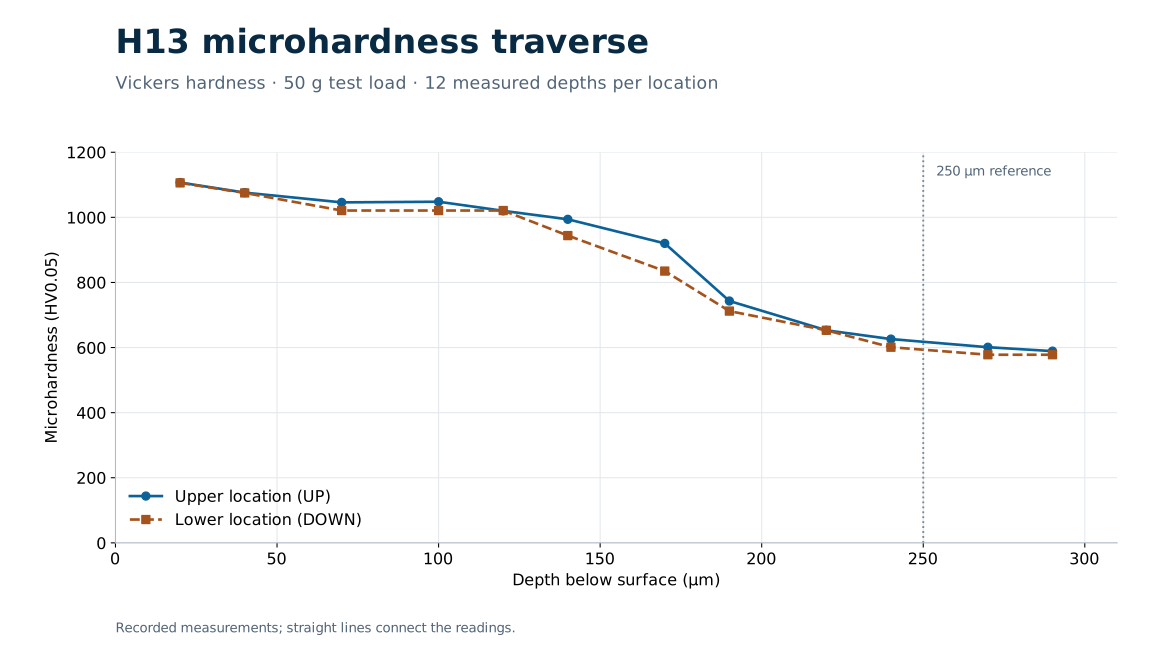
H13 plasma nitriding: case depth and hardness
Review the micrographs and 24-point microhardness traverse from the published technical case study.
ExplorePatt Technologies · Quebec, Canada
Extrusion strand dies, die components and breaker plates machined around the polymer, flow requirements and cleaning process.

Application review
Specify the resin, throughput, melt temperature and pressure, outlet geometry and cleaning method. We coordinate the flow passages, die face, steel and surface treatment.
| Component | Design and machining | Material and treatment options |
|---|---|---|
| Strand dies and die assemblies | Internal melt-distribution channels, transition geometry, strand-hole arrays, die faces and precision ground sealing surfaces designed for low hang-up and repeatable cleaning. | Patt PEA, PEA+, Patt Corrosion, H13, 420 / 17-4PH / 316L stainless + pulse plasma / ion nitriding |
Why Patt
Patt combines precision machining with its own tooling steels and in-house pulse plasma nitriding. Review PEA, PEA+, Patt Structural, Patt Tool and Patt Corrosion alongside conventional grades such as H13, D2 or 420 stainless steel for the actual application.
Our process
Review the polymer or part, operating conditions, drawings and production targets.
Coordinate flow geometry, material, surface treatment and the installation envelope.
Bring machining, nitriding and dimensional checks together in our Quebec facility.
Discuss installation, operation, cleaning and ongoing service with the team who built it.
Patt Technologies
Review the micrographs and 24-point microhardness traverse from the published technical case study.
Explore
See the geometry, installation envelope and material options behind the Patt wave upgrade.
ExploreDiscuss your project
Send the polymer, throughput and operating conditions, or the drawing and material requirements for your part.
sales@patt-tech.com