Approximately 800× better sliding-wear resistance
Patt reports an approximately 800-fold improvement in sliding-wear resistance compared with the untreated H13 substrate. This addresses material loss at sliding contacts.
Plasma nitriding · Case study
Patt consistently produces nitrided cases of 250 µm or more on H13. High near-surface hardness and a supporting diffusion zone help the treated steel withstand contact loading, sliding wear and galling.
A hard surface needs support beneath it. For H13 components exposed to repeated contact and sliding, Patt develops a diffusion case that distributes the transition from the hardened surface region toward the substrate. A case of 250 µm or more provides substantial load support below the working surface.
The process is designed to avoid intergranular nitrides (IGN) and brittle surface layers. Case depth, hardness profile and layer structure are considered together when matching treatment to the component and its service conditions.
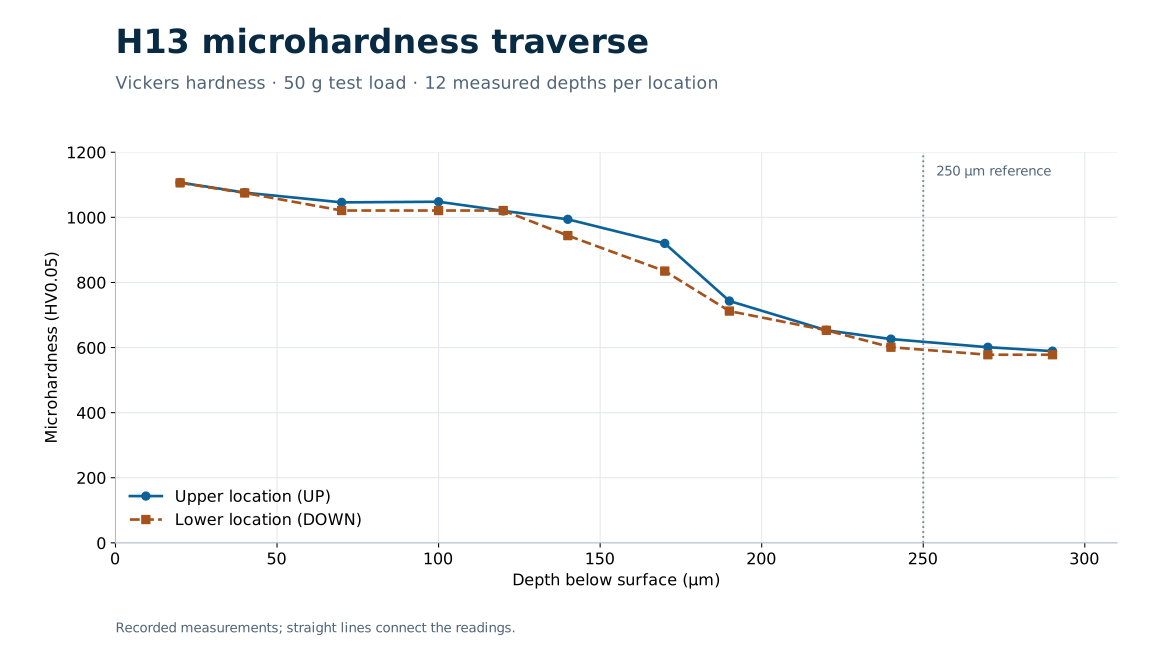
Two archived H13 traverses record hardness at the upper and lower sample locations. Each profile contains 12 measurements, from 20 to 290 µm below the surface. The graph connects the recorded readings without smoothing or extrapolation.
| Depth below surface (µm) | Upper location (HV0.05) | Lower location (HV0.05) |
|---|---|---|
| 20 | 1107 | 1106 |
| 40 | 1076 | 1075 |
| 70 | 1046 | 1021 |
| 100 | 1048 | 1021 |
| 120 | 1020 | 1021 |
| 140 | 994 | 944 |
| 170 | 920 | 835 |
| 190 | 743 | 712 |
| 220 | 653 | 653 |
| 240 | 626 | 601 |
| 270 | 601 | 578 |
| 290 | 589 | 578 |
At 20 µm, the two readings are 1,107 and 1,106 HV0.05. At 120 µm, they remain 1,020 and 1,021 HV0.05. Farther into the case, the readings are 626 and 601 HV0.05 at 240 µm, and 601 and 578 HV0.05 at 270 µm. These profiles show the hardness gradient beneath the working surface.
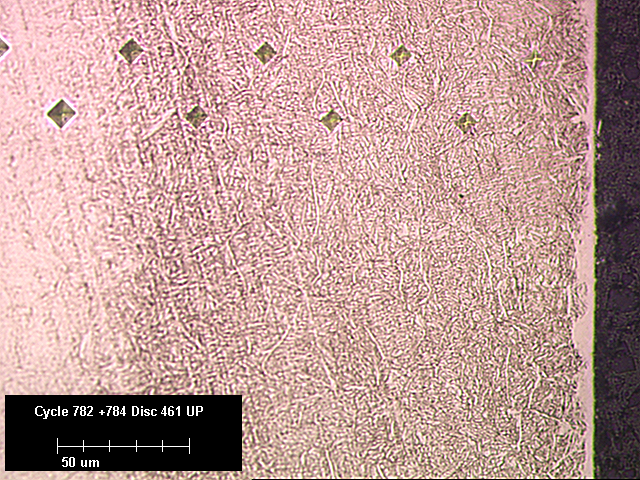
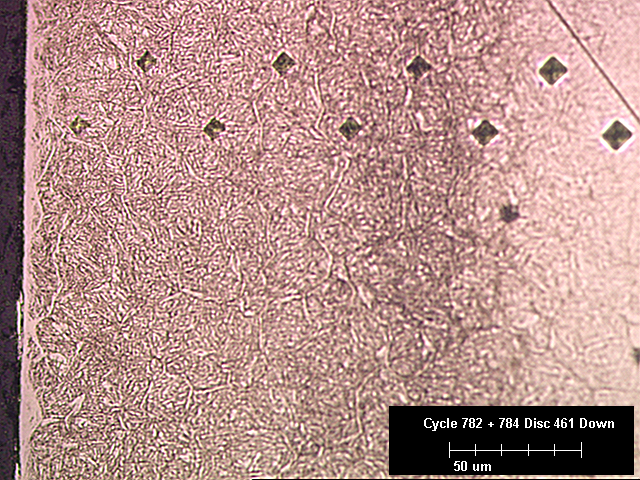
The selected micrographs retain their original annotations and 50 µm scale bars. Open either image to inspect it at full resolution.
Patt reports the following performance improvements for its H13 nitriding process. These wear results are separate from the microhardness measurements shown above.
Patt reports an approximately 800-fold improvement in sliding-wear resistance compared with the untreated H13 substrate. This addresses material loss at sliding contacts.
Patt also reports significantly improved resistance to galling, helping protect contacting surfaces against adhesive damage and material transfer during sliding.
For plastics tooling and other H13 components, the treatment can address sliding contacts where wear, adhesive damage and supporting case depth matter together. The target profile is selected around the actual contact conditions, component geometry and previous heat treatment.
For an application review, send the H13 heat-treatment condition, core hardness, drawing, working temperature, contact or wear problem, masking areas and final dimensional requirements.
Explore conventional plasma nitridingTell us about the material condition, geometry and wear problem. Patt can review the case-depth and surface requirements for your application.