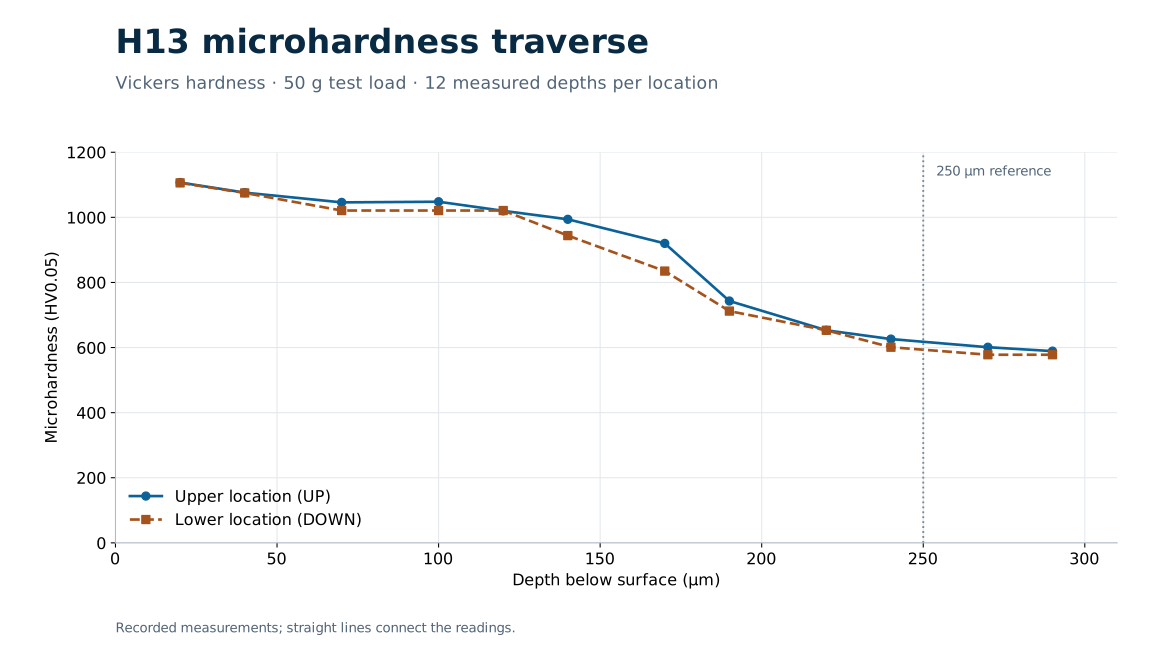
H13 plasma nitriding: case depth and hardness
Review the micrographs and 24-point microhardness traverse from the published technical case study.
ExploreCorrosion-focused tooling
Patt Corrosion prioritizes corrosion resistance for melt passages, dies and precision tooling exposed to aggressive processing residues and cleaning environments. Its lower working-hardness range supports a toughness-focused balance for components where corrosion is the principal material-selection driver.
Melt passages, dies and precision tooling exposed to aggressive residues or cleaning environments, where corrosion is the main material-selection driver.
| Property | Published engineering values |
|---|---|
| Core hardness | 42–48 HRC |
| Tensile strength | 1,420–1,680 MPa206–243.7 ksi |
| Charpy V-notch impact | 80–170 J59–125.4 ft·lb |
| Design priority | Patt Corrosion | H13 |
|---|---|---|
| Temper resistance | 70/100 | 90/100 |
| Polishability | 90/100 | 70/100 |
| Impact resistance | 90/100 | 70/100 |
| Core abrasive wear | 50/100 | 65/100 |
| Corrosion resistance | 95/100 | 10/100 |
| Core load capacity | 65/100 | 70/100 |
| Galling resistance | 40/100 | 55/100 |
Send the drawing, polymer or contact medium, working temperature, loading, wear or corrosion issue, finish and cleaning method. Patt can review the steel, machining and surface-treatment route together.
Discuss a tooling materialPatt Technologies
Review the micrographs and 24-point microhardness traverse from the published technical case study.
Explore
See the geometry, installation envelope and material options behind the Patt wave upgrade.
ExploreDiscuss your project
Send the polymer, throughput and operating conditions, or the drawing and material requirements for your part.
sales@patt-tech.com