Designed and manufactured in Saint-Eustache, Quebec, Canada since 1986

COLOSSUS™ · Case study

Backwashing candle filtration: 4× finer filtration at 15.8% lower system pressure.

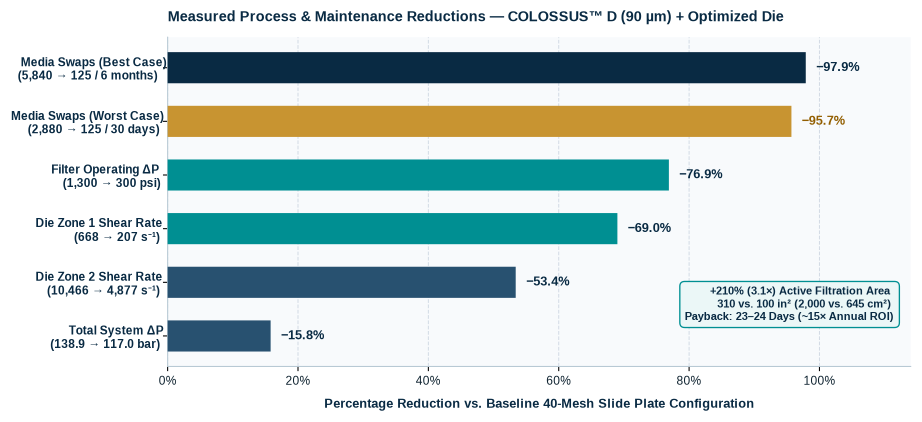
Replacing a coarse 40-mesh (~400 µm) slide-plate screen changer with a 90 µm (150-mesh) COLOSSUS™ D automatic backwashing candle system and rheologically optimized PATT die expanded active filtration area by 210%, cut filter operating ΔP by 76.9%, reduced screen replacements by 95.7% to 97.9%, and achieved verified payback in 23–24 days.

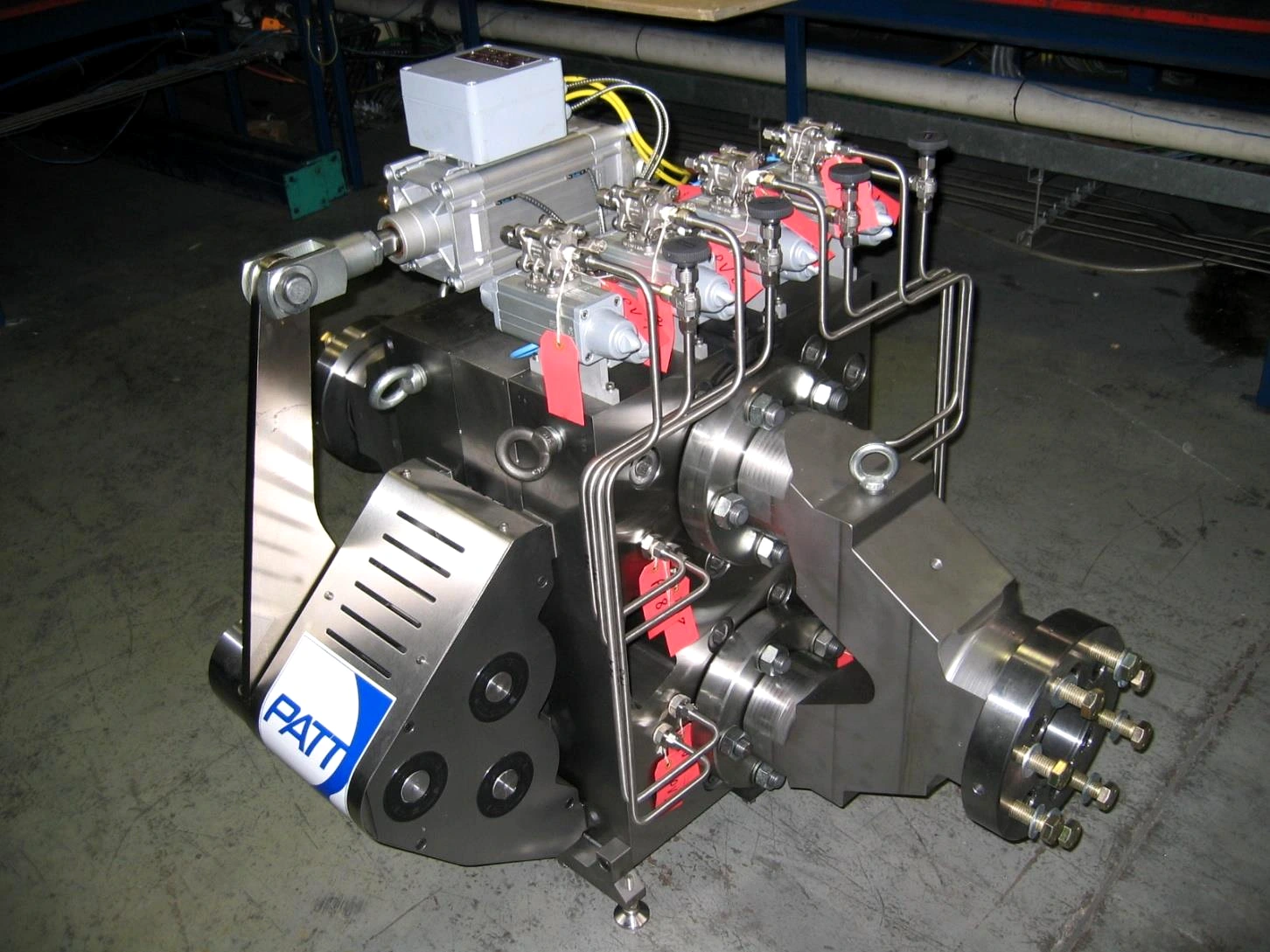
Manufactured PATT COLOSSUS dual-chamber automatic backwashing candle filtration unit

COLOSSUS™ Dual-Chamber Backwashing Candle System · Up to 7,000 cm² (1,085 in²)

+210% (3.1×) Active filtration area: 310 vs. 100 in² (2,000 vs. 645 cm²)
−76.9% ΔP Filter operating pressure drop: 300 vs. 1,300 psi (21 vs. 90 bar)
−95.7% to −97.9% Fewer media replacements while filtering ~4× finer (90 µm)
23–24 days Verified payback period (>15× annual return on system cost)

The process bottleneck: rapid blinding and high operating pressure

On a high-output LDPE (MFR 1) extrusion and compounding line, an existing single-cavity slide-plate screen changer with 100 in² (645 cm²) of flat filtration area was running a coarse 10/40-mesh (~400 µm) screen pack ahead of a 120-hole extrusion die. Under severe carbon-black agglomerate loading, filter operating differential pressure climbed to 1,300 psi (90 bar) and total melt-path pressure reached 2,015 psi (138.9 bar).

Operators were forced to index the slide plate every 45 minutes during best-case runs (32 swaps/day) and every 15 minutes during worst-case contamination surges (96 swaps/day). Each hydraulic shift triggered pressure spikes, off-spec scrap, and continuous screen consumption—while coarse 40-mesh openings still allowed fine agglomerates to pass into the finished compound.

PATT engineered an integrated upgrade pairing a COLOSSUS™ D dual-channel backwashing candle filter (20 engaged cylindrical cartridges providing 310 in² / 2,000 cm² of active 90 µm / 150-mesh area) with a rheologically balanced 240-hole PATT extrusion die.
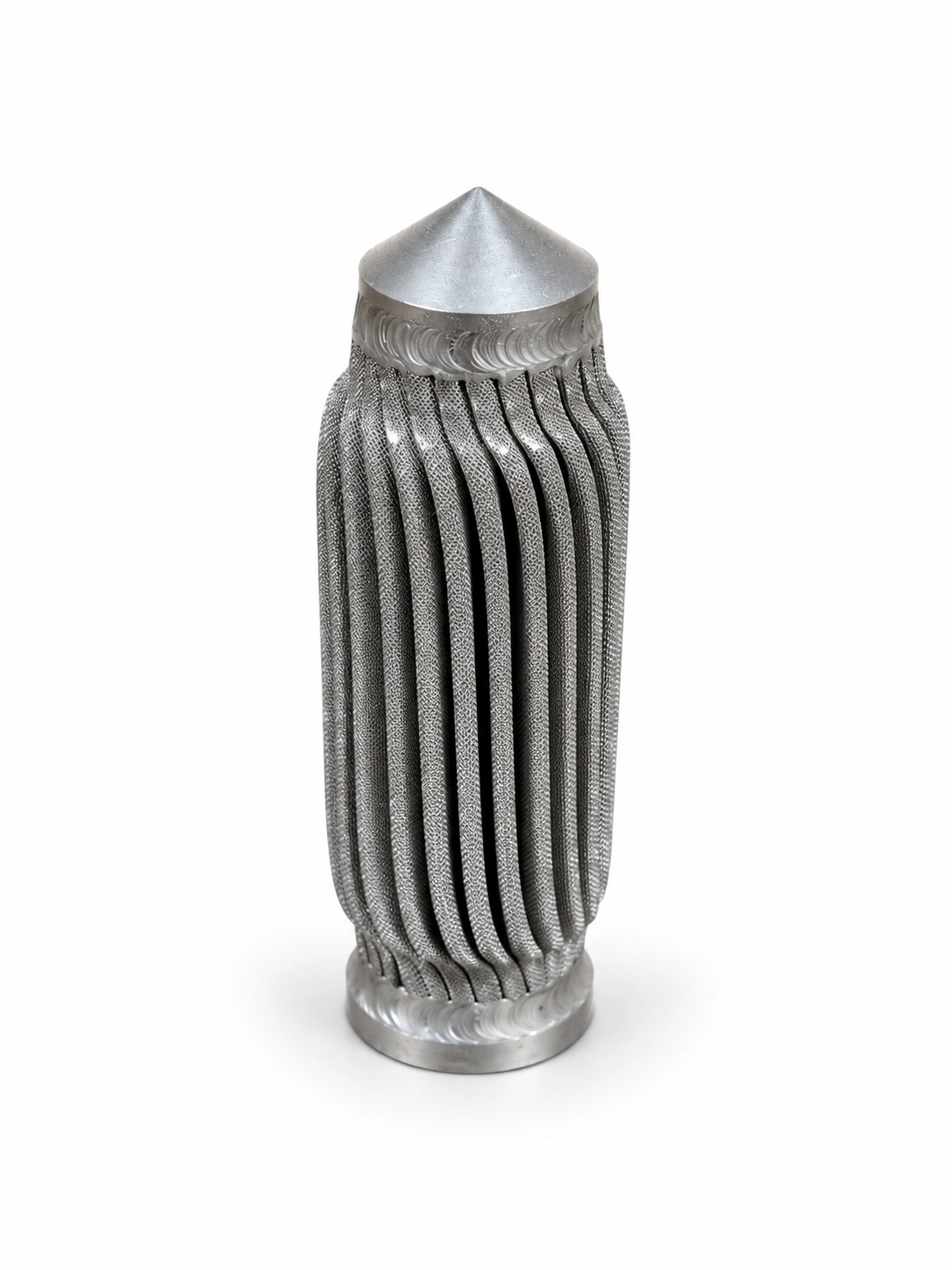
PATT sintered pleated cylindrical candle filter element for high-area polymer melt filtration
High-Surface Cylindrical Candle Filtration: Cylindrical candle elements pack 3.1× more active 90 µm filtration area into the melt path (310 vs. 100 in² / 2,000 vs. 645 cm²) than the original flat slide plate.

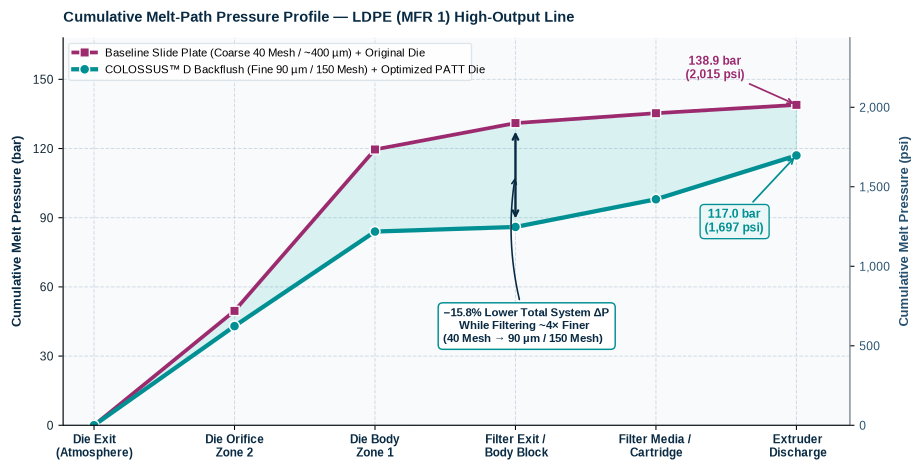
Cumulative pressure profile and rheological comparison

Step-by-step melt-path pressure calculations from die exit back to extruder discharge confirm that tripling active filtration area and balancing die orifice geometry lowers total system pressure by 15.8%—even after tightening filtration fineness by roughly 4× (from ~400 µm to 90 µm).

Station-by-station rheological engineering data

Measured and calculated melt-path parameters across filter and die zones (LDPE, MFR 1).
Melt-Path Parameter Baseline Slide Plate (40 Mesh) + Original Die COLOSSUS™ D (90 µm / 150 Mesh) + Optimized PATT Die Relative Change
Filtration finenessCoarse 40 mesh (~400 µm)Fine 90 µm (150 mesh)~4× finer capture
Active filtration area100 in² (645 cm²) · 1 cavity310 in² (2,000 cm²) · 20 engaged candles+210% (3.1×)
Filter operating ΔP (production)1,300 psi (90 bar)300 psi (21 bar)−76.9%
Die Zone 1 ΔP / shear rate70.0 bar (1,015 psi) · 668 s⁻¹ (120 holes)41.0 bar (595 psi) · 207 s⁻¹ (240 holes)−41.4% ΔP · −69.0% shear
Die Zone 2 ΔP / shear rate49.6 bar (719 psi) · 10,466 s⁻¹43.0 bar (624 psi) · 4,877 s⁻¹−13.3% ΔP · −53.4% shear
Total system cumulative ΣΔP138.9 bar (2,015 psi)117.0 bar (1,697 psi)−15.8%
Media change frequency (best case)1 screen / 45 min (~5,840 / 6 months)125 cartridges / 6 months (offline swap)−97.9% fewer swaps
Media change frequency (worst case)1 screen / 15 min (2,880 / 30 days)125 cartridges / 30 days (offline swap)−95.7% fewer swaps
Verified payback periodBaseline (high scrap & frequent shifts)23 days (best case) · 24 days (worst case)>15× annual ROI (~6.4% yr)

Quantified process and maintenance reductions

Because automated inline backflushing regenerates each filter element for up to 200 cycles—and spent elements are replaced offline without stopping the extruder—economic payback remains virtually identical across both normal and heavy contamination swings (23 vs. 24 days; worst-case annual return retains 95.1% of best-case gain).

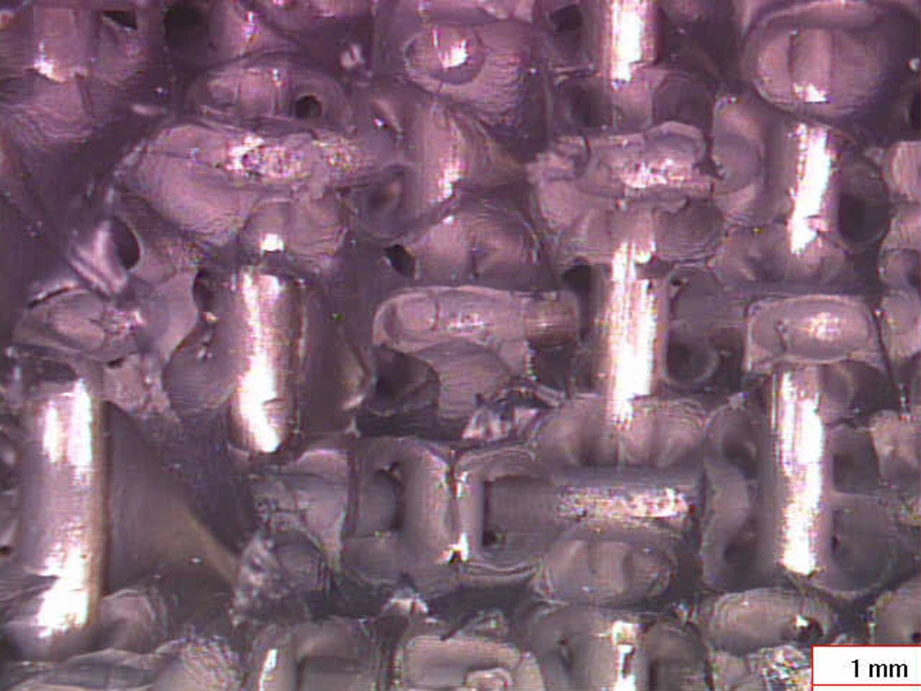
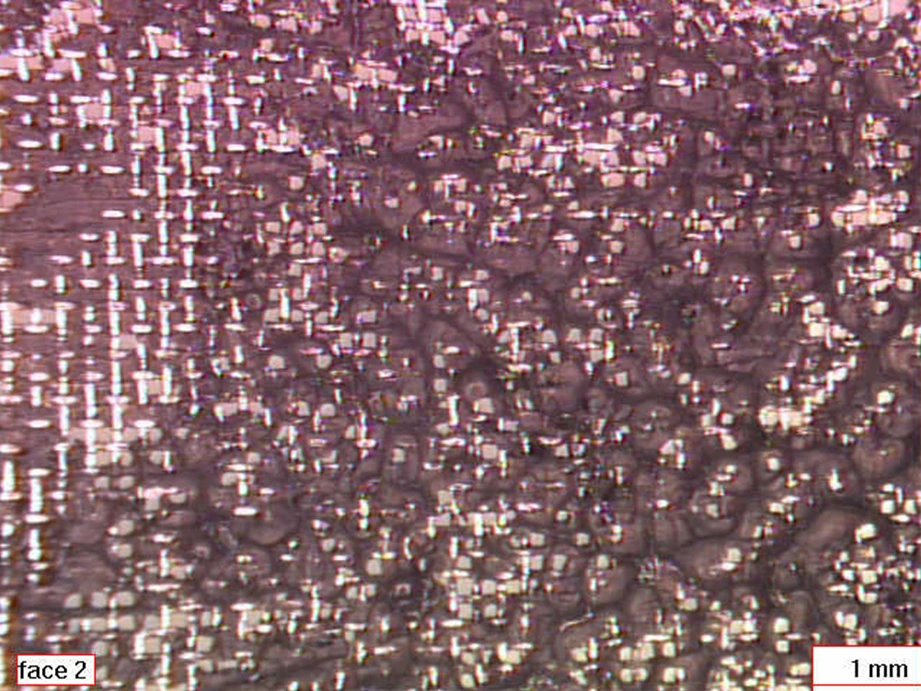
Contaminant root-cause analysis: screen residue microscopy

Laboratory scanning electron microscopy (SEM) on spent 40-mesh and 120-mesh screens from the line confirmed that retained residue consisted of 100% carbon black agglomerates. Because agglomerates rapidly bridge small flat-screen cavities, expanding active candle surface area by 3.1× and adding automatic backflush regeneration directly resolves the blinding mechanism.

Automatic backflush lifecycle and screen media cost

Beyond eliminating scrap and pressure surges, COLOSSUS™ automated backflushing regenerates screen media for 100–400 operating cycles before replacement—cutting annual consumable media expenditure to a fraction of flat-screen or belt systems.

01

Dual-channel continuous filtration

Two parallel melt channels expand active filtration area while maintaining uninterrupted, constant-pressure delivery to the die—eliminating the hydraulic pressure spikes and off-spec start/stop scrap inherent to intermittent slide-plate changers.

02

Automated regeneration up to 200+ cycles

Automated inline backflushing restores filtration capacity continuously with zero operator intervention, extending element service life across hundreds of cycles and permitting clean offline media changes with zero production stops.

Benchmark Screen Media Economics (1,500 kg/h · 3,307 lb/h Continuous Line):

A continuous extrusion line consuming 230 ft² (213,672 cm²) of flat filtration area over 22 operating days requires 9,712 cm²/day (1,505 in²/day) of fresh screen surface. A COLOSSUS™ disk carrying 5,652 cm² (876 in²) rotates just 1.72 revolutions/day. At 200 automatic backflush cycles per screen sleeve (116 operating days per sleeve), a 36-sleeve set requires only ~3 scheduled swaps per year across 340 working days—at roughly ~$5 per sleeve (~$540/year total screen media cost) with zero production interruption.

Applying COLOSSUS™ to your high-output line

COLOSSUS™ C and D systems scale from 1,385 to 7,000 cm² (215 to 1,085 in²) of active candle area for throughputs up to 61,700 lb/h (28,000 kg/h) and filtration ratings down to 1 µm—ideal for heavy PCR/PIR recycling, carbon-black or mineral-filled compounding, and high-tonnage pelletizing lines.

For an engineering sizing and pressure-drop review, run our interactive Filtration Sizing Calculator or send your polymer resin, MFR/viscosity, throughput, melt temperature, maximum allowable pressure, current screen mesh and contaminant profile below.

Explore COLOSSUS™ specifications
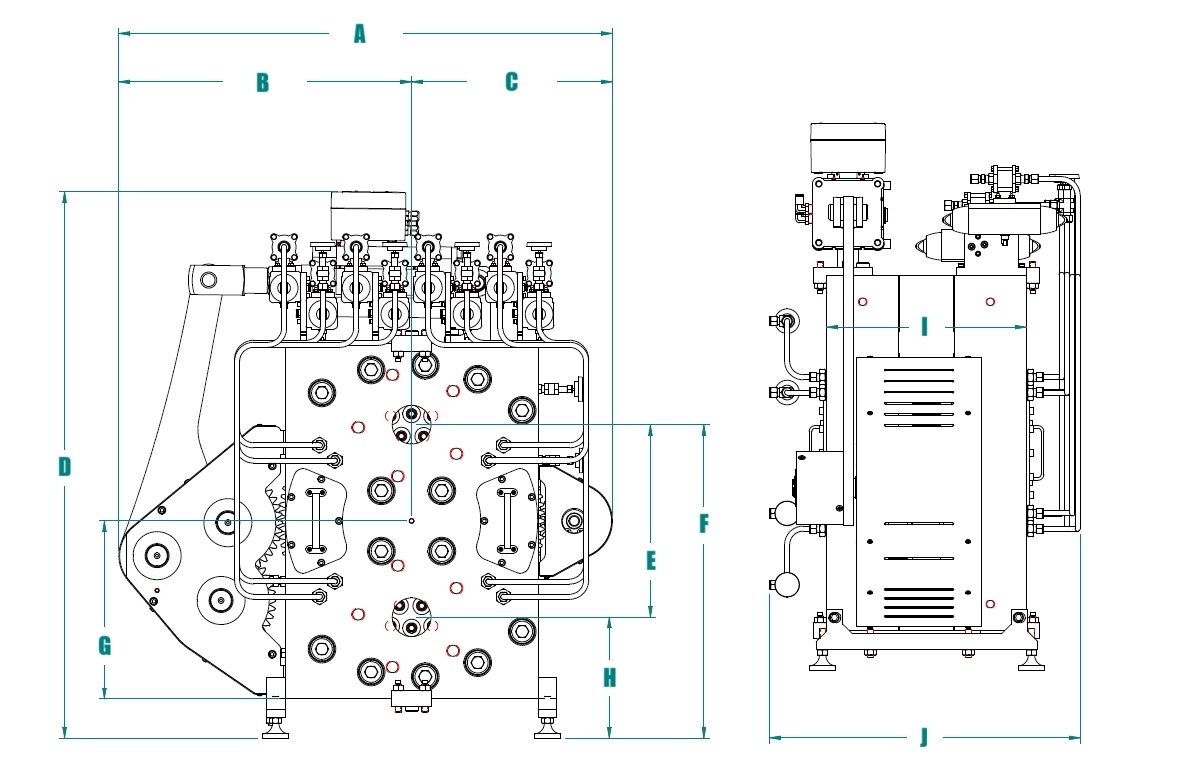
COLOSSUS external envelope dimension drawing showing installation reference dimensions A through J
COLOSSUS™ Installation Envelope (A–J): Engineered for seamless inline integration on high-output compounding, recycling, and pelletizing extruders.

Engineering Q&A

Key technical questions on COLOSSUS™ candle filtration

How can a finer 90 µm candle filter run at lower pressure than a 40-mesh slide plate?

Expanding active filtration area by 210% (from 100 in² / 645 cm² on a single flat slide-plate cavity to 310 in² / 2,000 cm² across 20 engaged cylindrical candle elements) drops melt velocity across the filter media dramatically. Combined with a rheologically balanced 240-hole extrusion die, filter operating ΔP fell by 76.9% (from 1,300 to 300 psi / 90 to 21 bar) and total system cumulative pressure fell by 15.8% (from 138.9 to 117.0 bar) even while tightening filtration fineness roughly 4×.

What is the verified payback period and consumable screen media cost?

Across both normal and severe carbon-black agglomerate loading, eliminating high-frequency slide-plate scrap and swaps achieved verified payback in 23 days (best case) to 24 days (worst case)—exceeding 15× annual return on system cost, with worst-case annual return retaining 95.1% of best-case gain. On a 1,500 kg/h (3,307 lb/h) continuous benchmark line running 340 days/year at 200 automatic backflush cycles per screen sleeve, consumable screen media averages roughly ~$5 per sleeve (~$540/year total).

Which extrusion and recycling lines benefit most from COLOSSUS™ backwashing candle filtration?

COLOSSUS™ C and D systems scale from 1,385 to 7,000 cm² (215 to 1,085 in²) of active candle area for throughputs up to 61,700 lb/h (28,000 kg/h) and filtration ratings down to 1 µm. They are engineered for heavy PCR/PIR recycling, carbon-black or mineral-filled compounding, high-tonnage pelletizing lines, and ultra-fine melt filtration duties where flat slide plates blind rapidly.

Patt Technologies

Articles & case studies

Discuss your project

Tell us what you need.

Send the polymer, throughput and operating conditions, or the drawing and material requirements for your line.

sales@patt-tech.com

+1 (450) 689-2497

Send your requirements and attach a drawing or specification. Our team will review your application.
PDF, DWG, DXF, STEP, IGES, JPG, PNG or ZIP · 15 MB maximum.