Designed and manufactured in Saint-Eustache, Quebec, Canada since 1986

ROTARY III™ · Case study

ROTARY III™ on an ABS extrusion line: +8.57% saleable output and 5.0% lower resin use.

On a 720 lb/h (327 kg/h) ABS extrusion line operating 350 days per year, replacing intermittent screen changes with a PATT ROTARY III™ constant-pressure screen changer eliminated 1.0 hour/day of downtime, removed an 800 psi (55 bar) pressure swing, increased annual saleable output by 8.57% (+518,112 lb / +235.0 t), and reduced raw resin consumption by 5.0% (302,400 lb / 137.2 t).

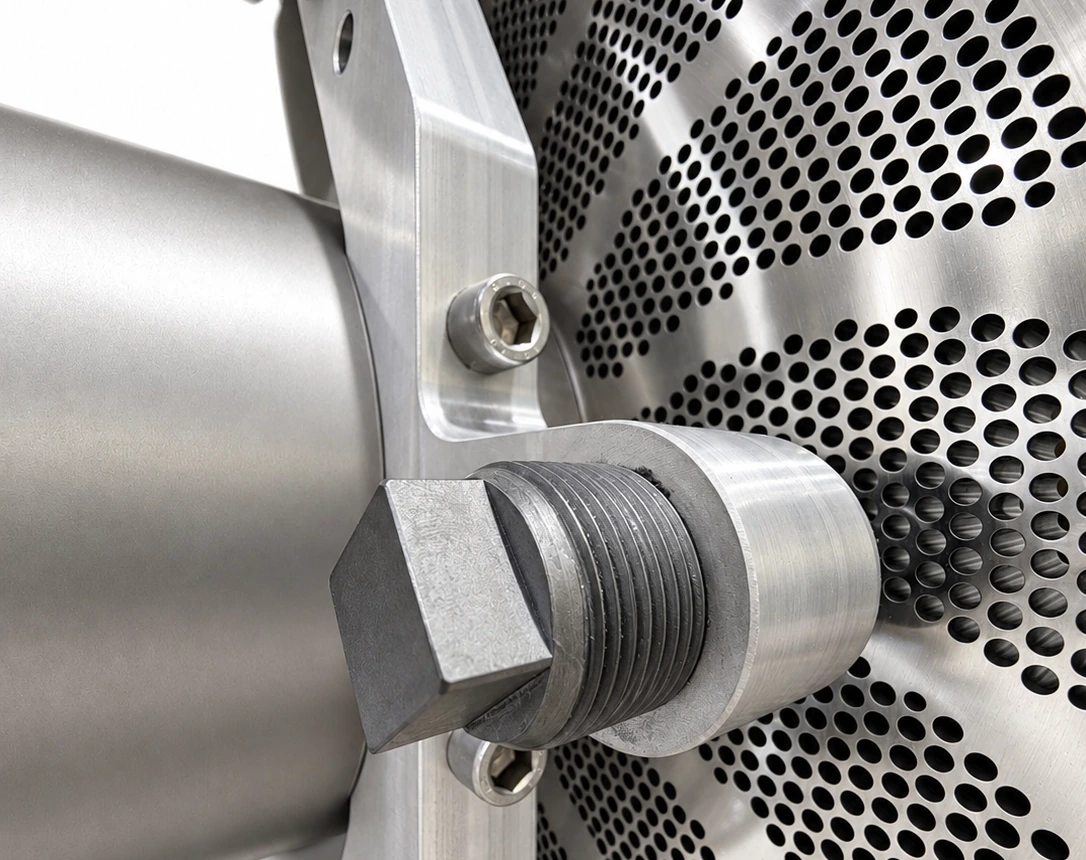
Close-up of precision-machined PATT ROTARY III rotary filter disk and heavy-duty clamp assembly

ROTARY III™ Precision Rotary Filter Disk · Sizes A–F · 70–17,000 lb/h (30–7,700 kg/h)

+8.57% Total annual saleable output gain (+518,112 lb / +235.0 t/yr)
−5.0% Direct raw resin reduction via tighter gauge (302,400 lb / 137.2 t/yr)
+4.17% Direct uptime recovered (4 × 15 min daily stops eliminated)
−100% ΔP swing Eliminates 800 psi (55 bar) cyclic pressure climb (2,500→3,300 psi)

Operating baseline: hidden losses between screen changes

A continuous single-screw ABS extrusion line producing 720 lb/h (327 kg/h)—equivalent to 17,280 lb/day (7,838 kg/day) and 6,048,000 lb/year (2,743 metric tons/year) across 350 operating days—relied on intermittent screen changes four times per day. Each change required 15 minutes of production stoppage and stabilization, directly forfeiting 1.0 hour of output every 24 hours (4.17% of scheduled runtime).

Less visible—but even larger—was the throughput penalty caused by rising back-pressure between changes. Starting clean at 2,500 psi (172 bar), head pressure climbed steadily to 3,300 psi (228 bar) before the next swap—an 800 psi (55 bar) differential pressure swing averaging 400 psi (27.6 bar) above clean-screen baseline. As pressure rose, screw back-flow increased, forcing operators to either accept lost throughput or over-gauge sheet/profile dimensions to stay above minimum thickness limits.

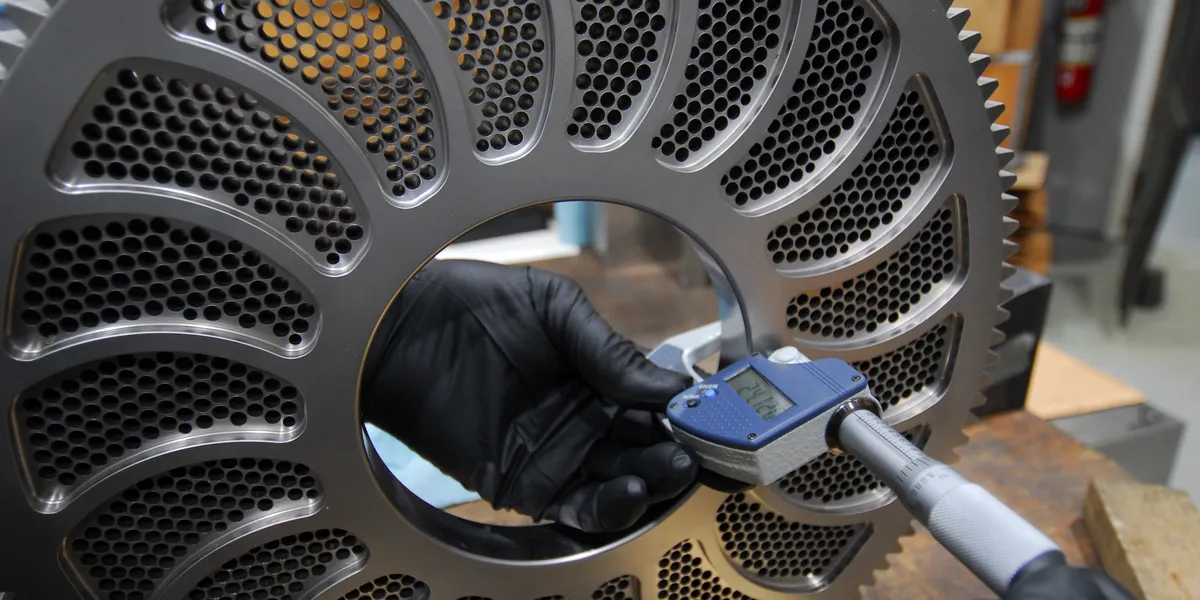
Precision dimensional flatness inspection of a PATT ROTARY III rotary filter disk
Sub-Micron Disk Flatness & 95% Cavity Area: Precision-lapped rotary filter disks maintain metal-to-metal sealing up to 6,500 psi (448 bar) with zero freeze-seal chillers or hydraulic power units.
PATT six-inch stem melt pressure transducers for closed-loop differential pressure control
Closed-Loop ΔP Sensing & Indexing: Melt-pressure transducers monitor upstream and downstream pressure continuously so Gen IV control holds ΔP constant and eliminates the 800 psi (55 bar) pressure climb.

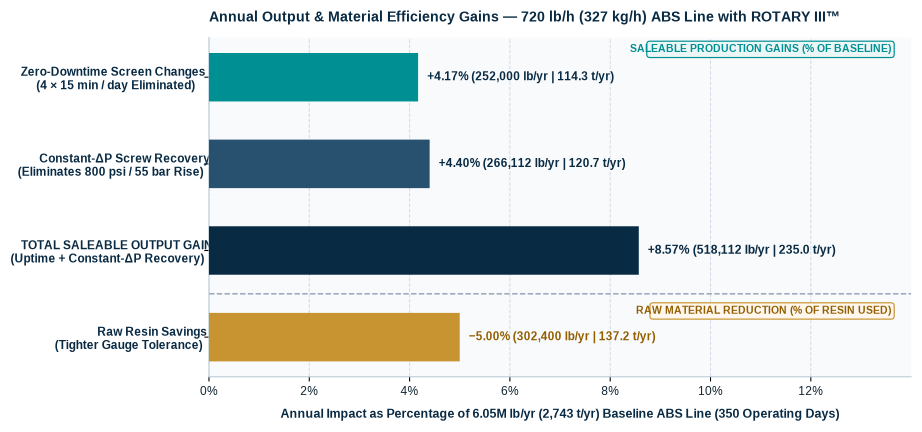
Annual output and material efficiency gains

Upgrading to continuous constant-pressure filtration with ROTARY III™ unlocks three compounding operational improvements on the exact same extruder—expressed below both as percentages of annual line baseline and in dual Imperial/Metric annual tonnage.

Step-by-step engineering calculation breakdown

Measured operating inputs and annual efficiency gains across 350 operating days/year (Metric & Imperial).
Efficiency Driver / Parameter Measured Operating Basis % of Annual Baseline Annual Physical Volume
Production line baselineABS · 720 lb/h (327 kg/h) · 350 days/yr100.0%6,048,000 lb (2,743.3 t)
1. Zero-downtime screen changes4 swaps/day × 15 min = 1.0 hr/day recovered+4.17% output+252,000 lb (+114.3 t)
Eliminated ΔP operating swing2,500 → 3,300 psi (172 → 228 bar) · 800 psi span−100% ΔP climb400 psi (27.6 bar) avg. excess ΔP removed
2. Constant-ΔP extruder recovery*−11% output per 1,000 psi ΔP → 4.40% recovered (31.7 lb/h)+4.40% output+266,112 lb (+120.7 t)
Total saleable output gain (1 + 2)Zero stops + full constant-ΔP screw delivery+8.57% output+518,112 lb (+235.0 t)
3. Raw resin consumption savingsTighter dimensional/gauge control under steady pressure (864 lb/day)−5.00% resin302,400 lb (137.2 t) saved

*Back-pressure throughput loss rate (−11% per 1,000 psi / 69 bar increase) derived from an independent laboratory single-screw extruder performance study.

Plant Value Formula — Benchmark Your Own Line

[ +8.57% × Annual Saleable Line Margin ] + [ 5.00% × Annual Resin Spend ] = Total Annual Economic Impact

Combined production and raw-material efficiency gain equals ~13.6% of annual line volume—achieved without increasing extruder screw size, drive power, or floor space.

Why all three operational gains stack simultaneously

Conventional screen-changer payback estimates often count only screen-change downtime. In continuous extrusion, stabilizing differential pressure delivers two additional structural gains that compound every shift.

01

Zero-downtime screen renewal (+4.17% uptime)

ROTARY III™ indexes a fresh portion of the rotary filter disk continuously into the melt stream via Gen IV adaptive ΔP control, eliminating all four 15-minute daily stoppages and reclaiming 350 full production hours per year.

02

Full screw pumping efficiency (+4.40% output)

Holding constant differential pressure (±40 psi / ±2.8 bar standard; configurable to ±1 bar / ±14.5 psi depending on application) eliminates the 400 psi average back-pressure rise that drives drag-flow slip inside single-screw extruders—restoring 31.7 lb/h (14.4 kg/h) of continuous output.

03

Tighter gauge control (−5.0% resin consumption)

When die inlet pressure no longer cycles by 800 psi (55 bar), downstream product thickness remains steady. Operators can run closer to minimum target gauge specification without risking thin spots, cutting raw ABS consumption by 5.0% per unit produced.

04

95% screen cavity utilization & metal-to-metal sealing

Precision-lapped, pulse-plasma-nitrided sealing surfaces deliver leak-free containment up to 6,500 psi (448 bar) with zero freeze-seal chillers or hydraulic power units, while optional 1.8× wave breaker plates expand active filtration area by 80% in the same line footprint.

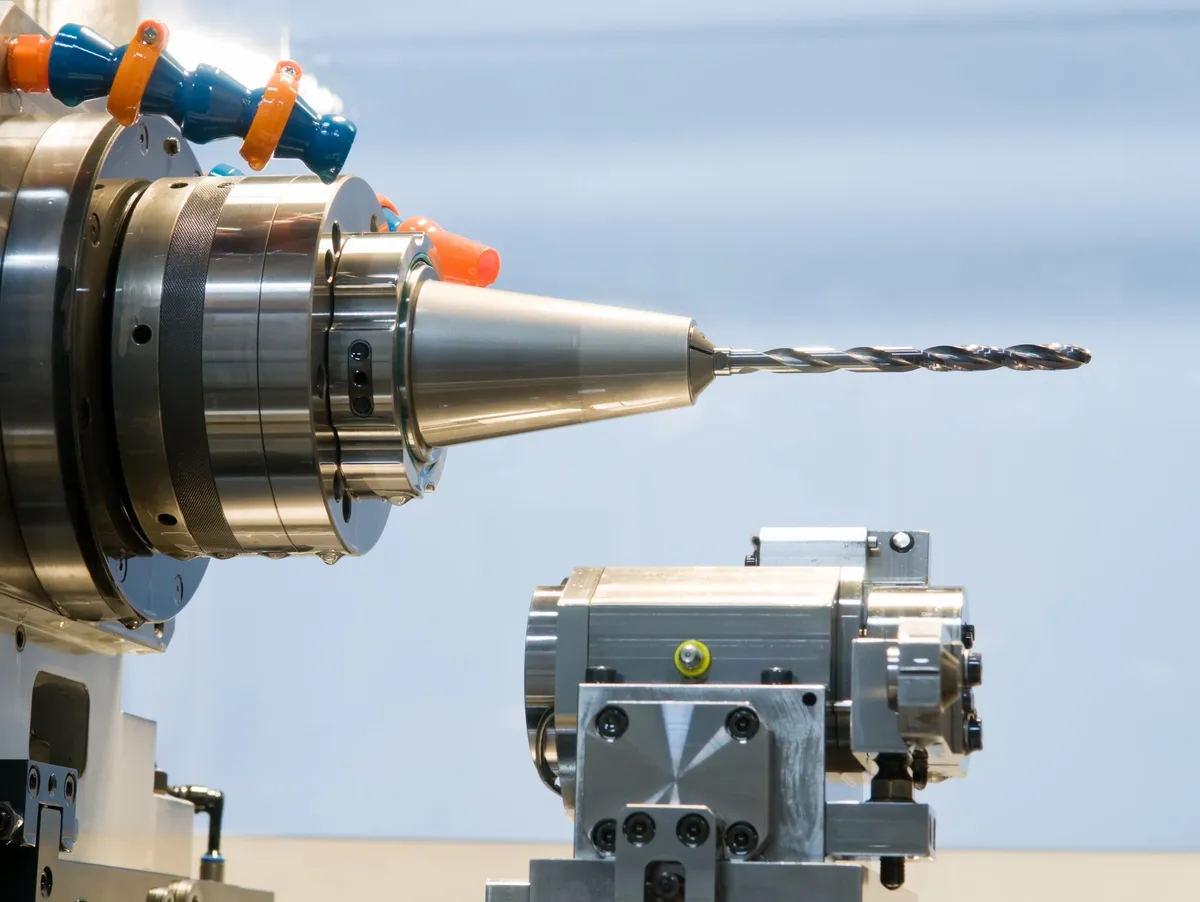
In-house high-precision CNC machining of ROTARY III components at Patt Technologies
In-House CNC Precision Machining: Manufactured under one roof in Saint-Eustache to tight tolerances for leak-free metal-to-metal sealing.
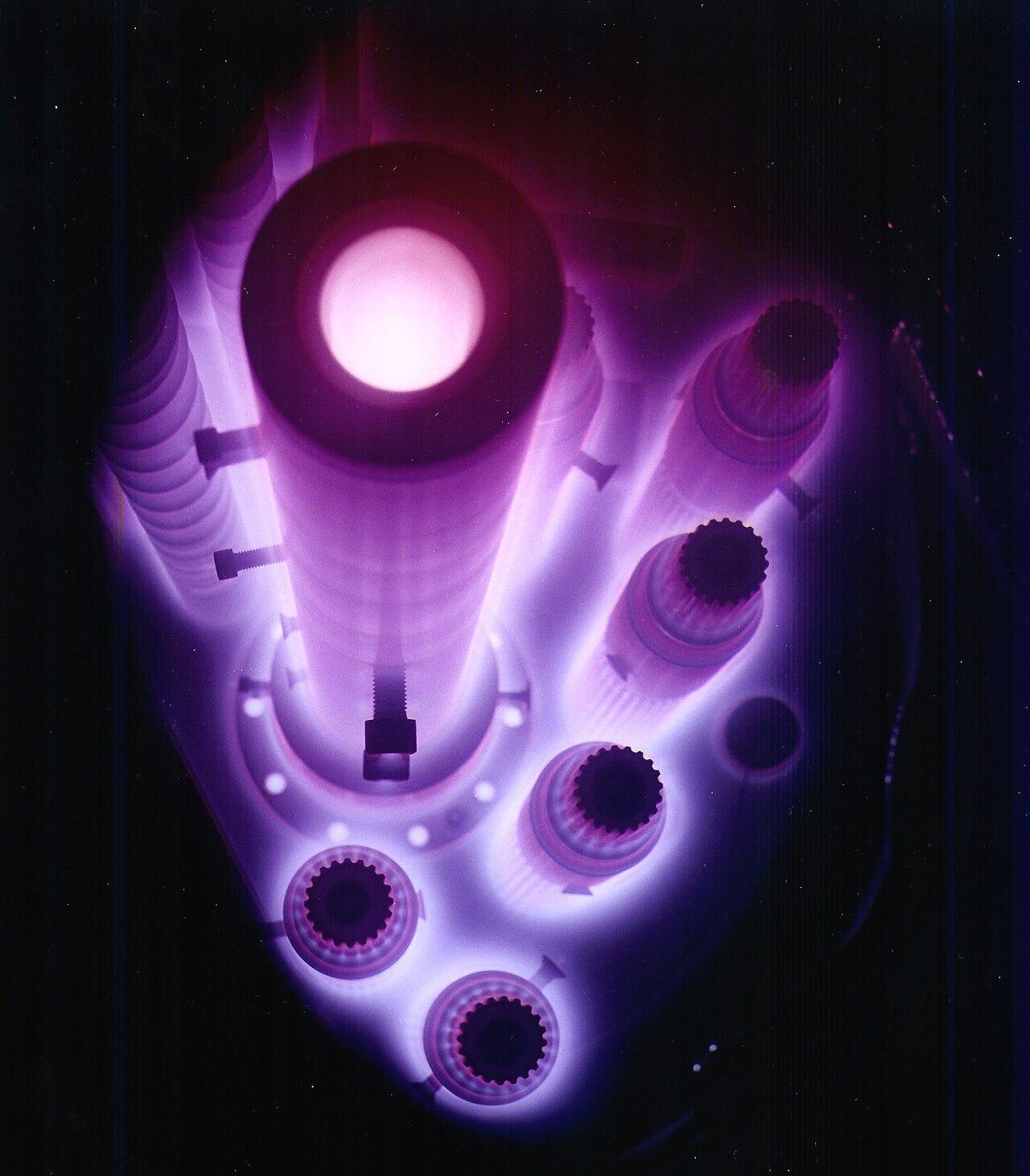
In-house pulse plasma nitriding furnace at Patt Technologies
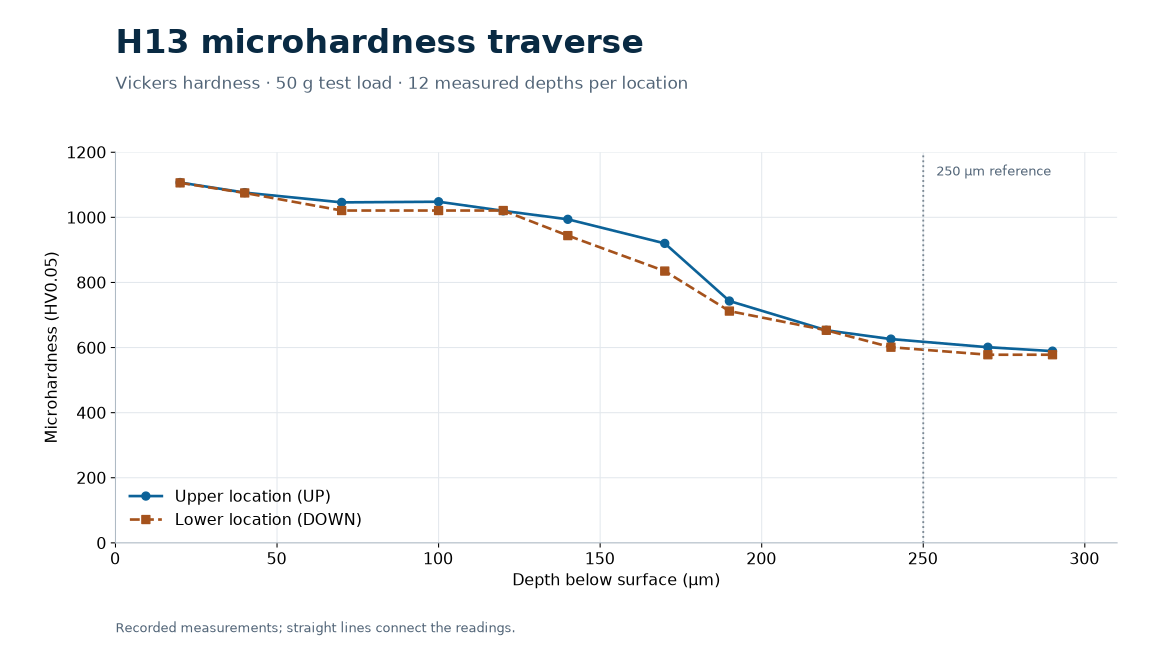
In-House Pulse Plasma Nitriding: Deep 250+ µm diffusion case hardens sliding faces against wear and galling without brittle coatings.
PATT CNC-machined 1.8x wave-shaped breaker plates
Optional 1.8× Wave Upgrade: Expands active filtration area by +80% in just ≈15 mm (0.59 in) of extra width for finer filtration or higher regrind.

Applying ROTARY III™ to your extrusion line

ROTARY III™ is built across frame sizes A–F covering 10–1,480 cm² flat active area (expandable to 2,664 cm² / 413 in² with 1.8× wave-shaped breaker plates) and throughputs from 70 to 17,000 lb/h (30 to 7,700 kg/h) across blown film, cast film, sheet, pipe, profile, compounding, and recycling lines.

To run a custom percentage output and material-savings calculation for your own line, enter your existing line pressures into our Filtration Sizing Calculator or send your polymer grade, nominal hourly throughput, screen-change frequency, clean-to-dirty pressure range, and target filtration fineness below.

Explore ROTARY III™ specifications & dimensions
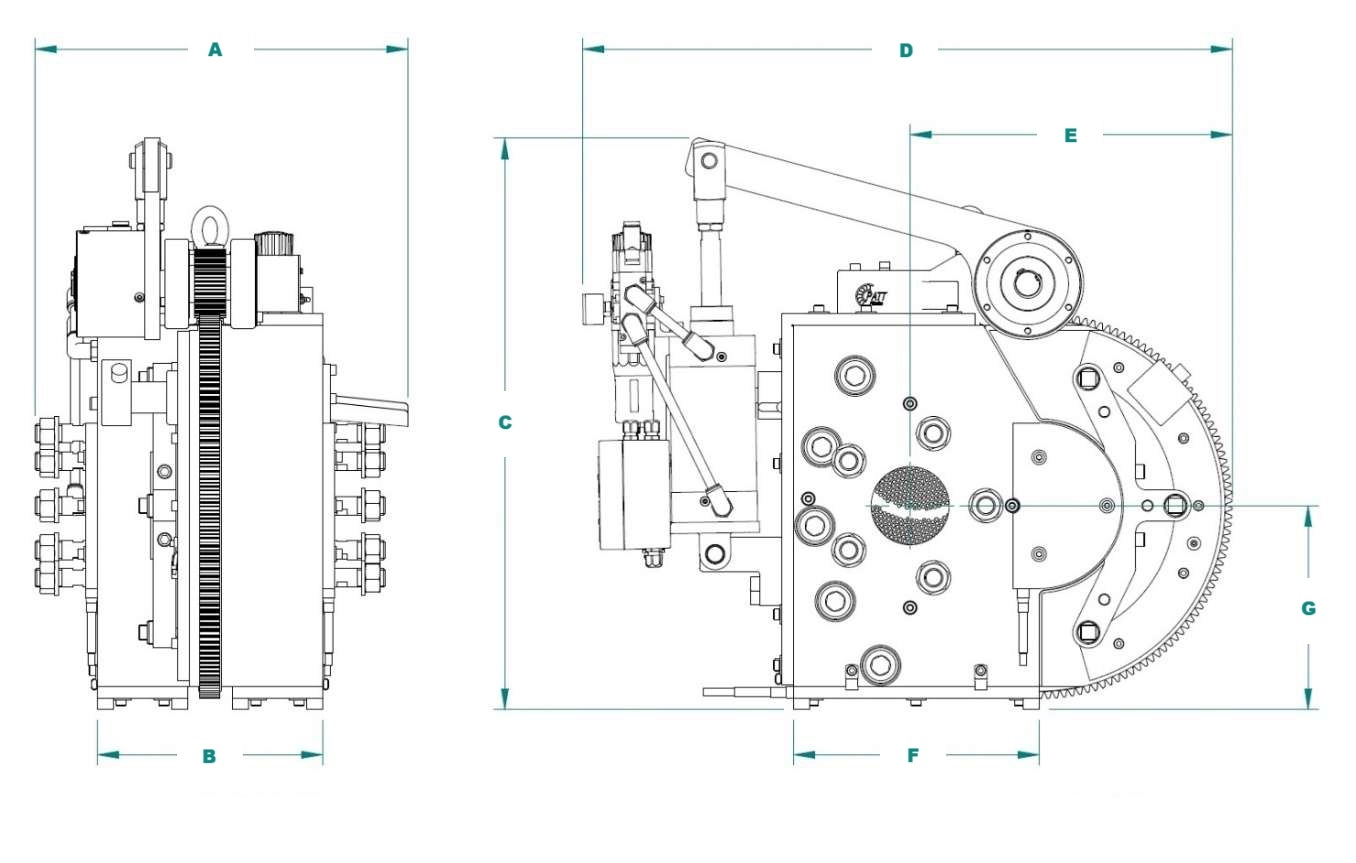
ROTARY III envelope dimension blueprint showing side and front reference dimensions A through G
ROTARY III™ Envelope Reference (A–G): Compact installation geometry engineered to drop cleanly into existing single- and twin-screw extrusion lines.

Engineering Q&A

Key technical questions on ROTARY III™ constant-pressure ROI

How does a constant-pressure screen changer increase extruder output beyond eliminating downtime?

On a single-screw extruder, rising head pressure between intermittent screen changes increases drag-flow back-slip inside the barrel. Eliminating an 800 psi (55 bar) cyclic pressure rise (2,500 to 3,300 psi—averaging 400 psi excess back-pressure) restored 4.40% of lost screw pumping delivery (+266,112 lb / +120.7 t/yr), stacking directly on top of the +4.17% uptime recovered from eliminating four daily 15-minute screen-change stops for a combined +8.57% annual saleable output gain.

Why does holding differential pressure steady reduce raw ABS resin consumption by 5.0%?

When die inlet pressure cycles by 800 psi (55 bar) across every screen-change interval, sheet and profile thickness drifts with the pressure wave, forcing operators to over-gauge above minimum wall thickness to avoid under-spec rejects. Stabilizing differential pressure with ROTARY III™ eliminates pressure-driven thickness drift so the line runs tighter to minimum target gauge—saving 5.0% raw ABS resin (302,400 lb / 137.2 t/yr).

How can I benchmark this percentage impact on my own extrusion line?

Use the verified plant value formula—[+8.57% × Annual Saleable Line Margin] + [5.00% × Annual Resin Spend]—with your own line's operating hours, screen-swap downtime and clean-to-dirty pressure rise, or enter your existing slide-plate or belt pressure data into Mode 2 of Patt's interactive Filtration Sizing Calculator for a frame-specific ROTARY III™ sizing review.

Patt Technologies

Articles & case studies

Discuss your project

Tell us what you need.

Send the polymer, throughput and operating conditions, or the drawing and material requirements for your line.

sales@patt-tech.com

+1 (450) 689-2497

Send your requirements and attach a drawing or specification. Our team will review your application.
PDF, DWG, DXF, STEP, IGES, JPG, PNG or ZIP · 15 MB maximum.